
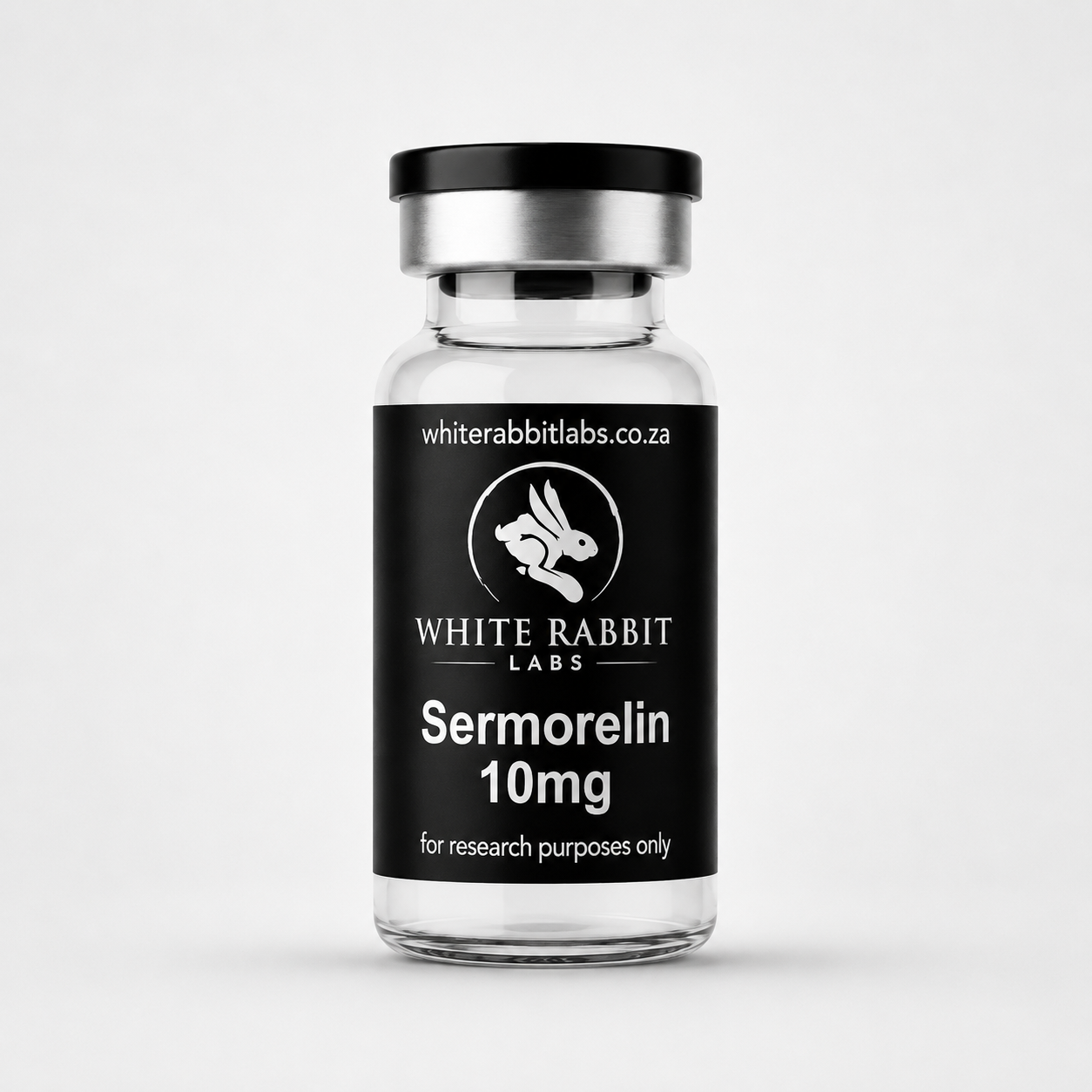
Sermorelin is a synthetic analogue of Growth Hormone-Releasing Hormone, also known as GHRH 1-29.
It is studied for its ability to stimulate the pituitary gland to produce and release endogenous growth hormone, GH, through the body’s natural signalling pathways.
Unlike direct growth hormone research compounds, Sermorelin is mainly studied for its effect on the GH axis, helping researchers explore natural, pulsatile growth hormone release rather than introducing external GH directly.
Sermorelin is commonly used in research related to GH production, body composition, recovery, energy, ageing and pituitary signalling.
How It Works
Sermorelin works by binding to GHRH receptors in the pituitary gland.
This receptor activity signals the pituitary to release growth hormone in a more natural, pulsatile pattern. This makes Sermorelin different from direct HGH research, as it works through the body’s own regulatory system rather than replacing GH externally.
The GH axis plays an important role in growth, metabolism, tissue repair, recovery and body-composition research models.
In simple terms, Sermorelin is studied for its ability to encourage the body’s own growth hormone release through natural pituitary signalling.
Observed Benefits
Research interest in Sermorelin includes:
- Support for natural growth hormone production.
- GH-axis and pituitary-function research.
- Body-composition research models.
- Energy and recovery-related research.
- Ageing and metabolic research models.
- More natural pulsatile GH release compared to direct HGH research.
- Preservation of the body’s own GH regulatory pathways in research settings.
In short, Sermorelin is an important research peptide for studying growth hormone signalling, pituitary function and natural GH-axis activity.
Possible Side Effects
Published research data suggests Sermorelin is generally well-tolerated in controlled study settings, but side effects and safety outcomes can vary depending on the model, route and protocol.
Possible side effects reported in research contexts may include:
- Injection-site reactions.
- Headache.
- Flushing.
- Dizziness.
- Temporary discomfort depending on the research model and administration route.
Sermorelin is often considered to have a more favourable research profile than direct HGH because it works through natural GH-axis signalling, but long-term safety has not been fully established.
Bottom line: Sermorelin remains an investigational compound and should be handled strictly as a laboratory research material.
Reconstitution, Dosage and Cycling, Research Only
Sermorelin is typically reconstituted with bacteriostatic water under controlled laboratory conditions.
There are no approved human or animal dosing guidelines for research-use Sermorelin.
Research dosages vary widely depending on the study protocol, model type, route, concentration and research objective. Published study protocols have often explored microgram-level quantities.
No standard research cycle has been established.
Researchers should follow validated study protocols, sterile laboratory handling procedures and applicable institutional safety guidelines.
For research purposes only. Not for human or animal consumption.
Fun Facts
- Sermorelin is based on the first 29 amino acids of Growth Hormone-Releasing Hormone.
- It was originally developed for clinical research into growth hormone deficiency.
- Sermorelin is often studied as a GH secretagogue, meaning it encourages GH release rather than acting as direct GH.
- It is popular in GH-axis research because it works through the pituitary gland.
- Researchers are interested in Sermorelin because it may support more natural, pulsatile GH signalling compared to direct HGH research models.
Citations and Sources
Most available Sermorelin research focuses on growth hormone release, pituitary signalling, GH-axis regulation and growth hormone deficiency models.
Key research areas include:
- Growth Hormone-Releasing Hormone analogue research.
- Pituitary gland and GH-axis signalling studies.
- Endogenous growth hormone release models.
- Body-composition, recovery and metabolic research.
- Ageing-related GH secretion studies.
- Comparisons between GH secretagogues and direct HGH research models.
Takeaway: Sermorelin is a valuable research compound for studying natural growth hormone release and GH-axis regulation, but more research is needed before any safety, treatment or human-use conclusions can be made.
Our Take
Sermorelin is a popular research tool for studying the GH axis because it works with the body’s natural regulatory systems.
Its ability to stimulate endogenous, pulsatile growth hormone release makes it especially interesting for research into pituitary function, recovery, body composition, ageing and metabolic signalling.
Promising, but still strictly research-only.
Disclaimer
Important disclaimer upfront: Sermorelin is not approved by SAHPRA, the FDA, or any major regulatory authority for medical use in this research-product context.
This product is sold strictly for laboratory research purposes only. It is not intended for human or animal consumption, diagnosis, treatment, prevention, or cure of any disease. The information provided is for educational and research context only and should not be interpreted as medical advice.



Reviews
There are no reviews yet.