
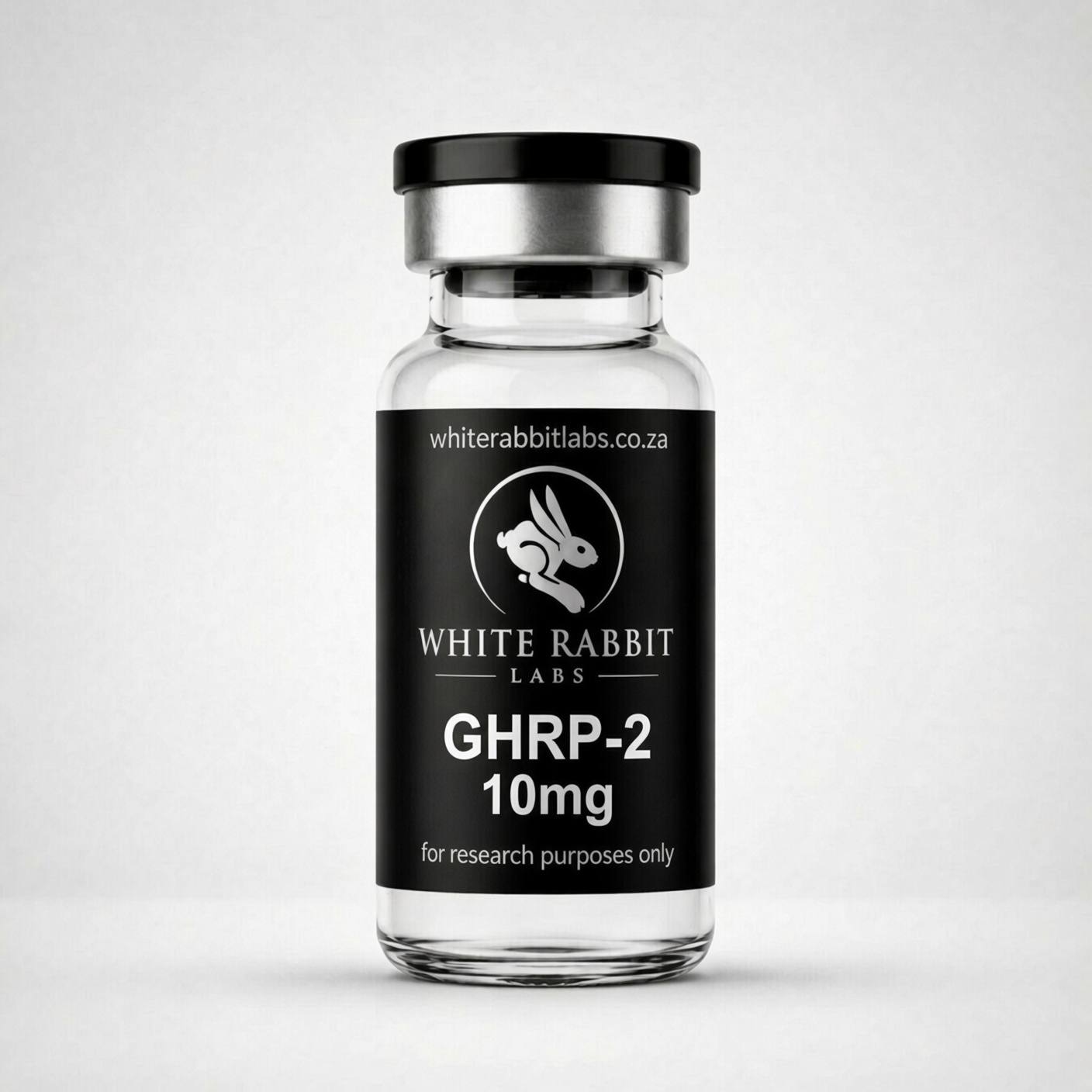
GHRP-2, also known by its international nonproprietary name pralmorelin, is a synthetic hexapeptide growth hormone secretagogue with the amino acid sequence D-Ala-D-2-Nal-Ala-Trp-D-Phe-Lys-NH₂. It has the molecular formula C₄₅H₅₅N₉O₆ and a molecular weight of approximately 818 Da (CAS 158861-67-7). The incorporation of D-amino acids (particularly D-alanine and D-2-naphthylalanine) and a C-terminal amide enhances its resistance to enzymatic degradation compared with earlier analogs.
GHRP-2 functions primarily as a high-affinity agonist at the GHS-R1a receptor, the same receptor activated by the endogenous hormone ghrelin. Receptor activation couples to Gq/11 proteins, stimulating phospholipase C, generating IP₃ and diacylglycerol, and elevating intracellular calcium. This calcium signal drives the exocytosis of growth hormone vesicles from anterior pituitary somatotroph cells. The pathway is mechanistically distinct from that of growth hormone-releasing hormone (GHRH), which operates mainly through cAMP signaling. As a result, GHRP-2 and GHRH (or GHRH analogs) frequently produce synergistic GH release when administered together.
Human and animal studies have consistently shown that GHRP-2 produces strong, dose-dependent GH pulses, often exceeding the response to GHRH alone. Peak GH levels typically occur within 30–60 minutes after administration. In addition to GH, it can produce modest elevations in prolactin, ACTH, and cortisol. It also increases food intake in a manner similar to ghrelin, though this orexigenic effect is generally milder than that observed with GHRP-6. Chronic or repeated administration has been associated with increased GH secretion and, in some models, improvements in growth parameters or body composition markers, though long-term therapeutic data outside of diagnostic use remain limited.
Pralmorelin received regulatory approval in Japan in 2004 as a single-dose intravenous diagnostic agent for evaluating growth hormone deficiency (marketed as GHRP Kaken). It is not approved by the FDA or most other regulatory agencies for therapeutic use and is classified as a prohibited substance by the World Anti-Doping Agency (WADA). Outside of its approved diagnostic application in Japan, GHRP-2 is supplied and studied as a research compound.
Note: This product is intended for laboratory research use only. It is not for human or veterinary consumption, diagnosis, or treatment.




Reviews
There are no reviews yet.