
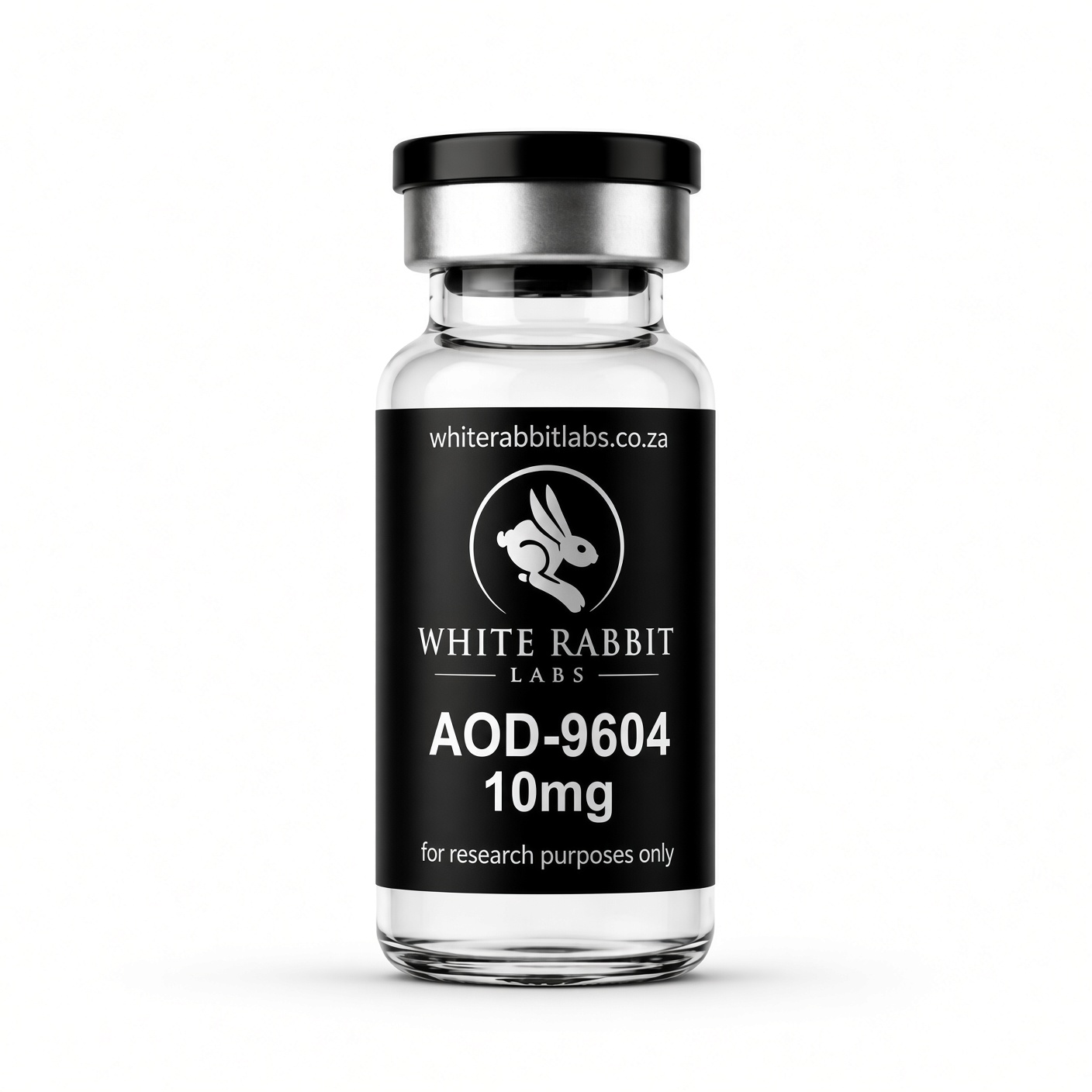
AOD-9604: Targeted Fat Metabolism Without the Growth Hormone Trade-Offs
In the world of performance and metabolic peptides, few compounds illustrate the principle of selective design as clearly as AOD-9604. Originally developed in the 1990s at Monash University in Australia by Professor Frank Ng and later advanced by Metabolic Pharmaceuticals, AOD-9604 (Anti-Obesity Drug 9604) is a synthetic hexadecapeptide that isolates the lipolytic portion of human growth hormone while discarding the regions responsible for growth promotion, IGF-1 elevation, and disruption of glucose metabolism.
The full human growth hormone molecule is a 191-amino-acid protein with multiple functional domains. Researchers identified that the C-terminal fragment (amino acids 177–191) carried the majority of growth hormone’s fat-mobilizing activity. By synthesizing this fragment and adding a tyrosine residue at the N-terminus for improved stability, scientists created a peptide that could stimulate fat breakdown without triggering the broader endocrine cascade associated with intact HGH. The resulting molecule — sequence Tyr-Leu-Arg-Ile-Val-Gln-Cys-Arg-Ser-Val-Glu-Gly-Ser-Cys-Gly-Phe — has a molecular weight of approximately 1,817 daltons and is commonly referred to as HGH Fragment 176-191 or Tyr-hGH 177-191.
Mechanism of Action: Precision Lipolysis
AOD-9604 works primarily through a pathway distinct from classical growth hormone receptor signaling. Instead of binding the GH receptor and activating the JAK2/STAT5 cascade that leads to IGF-1 production, it engages beta-3 adrenergic receptors expressed on adipocytes, particularly in white and visceral adipose tissue.
Activation of these receptors increases intracellular cyclic AMP (cAMP), which activates protein kinase A (PKA). PKA then phosphorylates hormone-sensitive lipase (HSL) and perilipin, triggering the hydrolysis of stored triglycerides into free fatty acids and glycerol. These fatty acids can then be oxidized for energy. Concurrently, AOD-9604 inhibits de novo lipogenesis by down-regulating key enzymes such as fatty acid synthase and acetyl-CoA carboxylase, reducing the conversion of excess calories into new fat stores.
This dual action — promoting fat breakdown while limiting fat synthesis — occurs without measurable elevation of circulating IGF-1 and without the diabetogenic effects commonly seen with full-length growth hormone. Preclinical studies in obese animal models demonstrated reduced body-weight gain, increased fat oxidation, and preferential effects on adipose tissue while sparing lean mass. Human clinical trials later confirmed the absence of IGF-1 elevation and the lack of impact on glucose metabolism or insulin sensitivity.
Research Background and Clinical Findings
AOD-9604 progressed through multiple phases of human clinical development. Phase I and early Phase II studies established a favorable safety profile across a range of doses, with tolerability described as indistinguishable from placebo. No serious adverse events related to the peptide were reported, no anti-AOD-9604 antibodies were detected, and oral glucose tolerance tests confirmed the absence of negative effects on carbohydrate metabolism.
In a 12-week efficacy trial, participants receiving approximately 1 mg daily (oral) showed greater fat loss than placebo. A larger Phase IIb trial involving over 500 subjects, however, produced more modest results that did not meet the primary statistical endpoint for weight loss at the doses and duration tested. Development as an oral anti-obesity drug was subsequently discontinued. Despite this, the compound retained interest for its clean safety record and selective mechanism. It later received self-affirmed GRAS (Generally Recognized As Safe) status in the United States for certain food-related applications, further underscoring its low toxicity profile at the doses studied.
More recent research interest has expanded beyond pure fat loss. Preclinical and early clinical exploration has examined potential chondroprotective (cartilage-supporting) effects, leading to investigation in joint and musculoskeletal applications. The same selectivity that prevents growth-promoting activity appears to allow tissue-specific metabolic support without systemic hormonal disruption.
Practical Considerations and Research Context
AOD-9604 is typically supplied as a lyophilized peptide for research use and is commonly reconstituted for subcutaneous administration in laboratory and clinical research settings. Because its half-life is relatively short (estimated around 30 minutes), research protocols often emphasize consistent daily administration, frequently in a fasted state, to align with periods of elevated fat mobilization. Typical research dose ranges explored in the literature and practice fall between 250–500 mcg daily, though human trials primarily utilized oral dosing up to 1 mg.
It is important to note that AOD-9604 is not an FDA-approved drug for weight loss or any therapeutic indication. It remains available primarily through compounding pharmacies under applicable regulatory frameworks or as a research chemical. Regulatory bodies have flagged considerations around peptide characterization, potential immunogenicity with certain routes, and the need for careful quality control. Users and researchers should therefore prioritize verified purity, proper handling, and professional oversight.
Distinguishing Features
What sets AOD-9604 apart from both full-length growth hormone and many modern metabolic agents is its mechanistic specificity:
• It does not stimulate IGF-1 production.
• It does not promote linear growth, organ growth, or significant increases in lean mass.
• It does not impair insulin sensitivity or elevate blood glucose.
• It acts directly on adipose tissue rather than primarily through appetite suppression or central nervous system pathways.
These characteristics make it conceptually complementary to other approaches that focus on caloric control, exercise, or incretin-based therapies. Where appetite-suppressing peptides reduce energy intake, AOD-9604 is designed to influence how the body handles stored energy once it is present.
Who Might Research AOD-9604?
Interest in AOD-9604 is highest among those studying body composition, targeted fat metabolism, and recovery of metabolic flexibility. It appeals to researchers exploring alternatives or adjuncts to growth hormone that avoid IGF-1 elevation, as well as those investigating joint and connective-tissue applications. Athletes and high-performance individuals sometimes examine it in the context of recomposition goals where preserving lean mass while supporting fat oxidation is desirable.
As with any research peptide, results depend heavily on the broader context — nutrition, training stimulus, recovery practices, and individual metabolic status. AOD-9604 is not a substitute for foundational lifestyle factors; it is a tool designed to influence specific adipose-tissue pathways.
Closing Perspective
AOD-9604 represents an elegant example of molecular dissection: taking a complex hormone, isolating the desired functional domain, and discarding the unwanted effects. Its development history — from academic discovery through clinical trials to ongoing research use — illustrates both the promise and the challenges of peptide-based metabolic interventions.
With a well-documented safety profile in human studies, a clear mechanistic rationale centered on beta-3 adrenergic-mediated lipolysis, and an absence of classic growth-hormone side effects, AOD-9604 continues to attract attention from researchers seeking precise tools for fat metabolism and body composition. Whether evaluated in isolation or as part of a broader protocol, it stands as a focused, non-growth-promoting option within the expanding landscape of metabolic peptides.


Reviews
There are no reviews yet.